What Does It Means When the Fuel Trim Reads -30

Home, Machine Repair Library, Auto Parts, Accessories, Tools, Manuals & Books, Automobile Blog, Links, Alphabetize

What Is Fuel Trim?
by Larry Carley copyright 2019 AA1Car.comFuel Trim is the adjustment the engine computer (PCM) makes to the fuel mixture to maintain a balanced air/fuel ratio. Fuel trim is usually displayed as a PERCENTAGE reading on a scan tool.
For lowest emissions, the engine computer tries to keep the fuel mixture balanced around 14.vii to ane (14.7 parts of air to one function fuel). If the air/fuel ratio is less than 14.7 to one (say 12 to ane), the fuel mixture is RICH. A rich fuel mixture tin produce more ability (upward to a bespeak) but it as well increases fuel consumption and emissions. Conversely, if the fuel mixture is greater than 14.7 to ane (say 16 to i), information technology is LEAN. A lean fuel mixture reduces fuel consumption merely can besides increase emissions if the air/fuel mixture is and so lean that it fails to ignite and causes lean misfire.
The engine computer monitors the air/fuel ratio via the oxygen sensor(south) in the frazzle manifold(southward). An oxygen sensor is substantially a RICH or LEAN indicator. When the engine is running lean (too much air and not plenty fuel), the O2 sensor generates a low voltage signal that tells the engine reckoner more fuel is needed. When the engine is running rich (too much fuel and non enough air), the O2 sensor produces a college voltage bespeak that tells the engine computer the engine is getting too much fuel and to cut back the fuel delivery. On vehicles that have an Broad Ratio Air/Fuel sensor (WRAF) or A/F sensor, the sensor tells the estimator the exact air fuel sensor and so the computer tin can increase or subtract the fuel delivery as needed.
Accurate fuel trim values require an authentic feedback signal from the Oxygen sensor, otherwise the engine computer has no way of knowing whether the fuel mixture is running rich or lean.
When a cold engine is first started, it may take 10 to 30 seconds or more for the heaters inside the oxygen sensors to warms the sensors upward to operating temperature. Until that indicate is reached and the fuel feedback control system goes into "airtight loop", the fuel mixture is stock-still at a predetermined value so no fuel trim adjustments are made. But in one case the Oxygen sensors are hot and the coolant temperature is loftier enough for the reckoner to go into closed loop, the computer starts to generate fuel trim values and brand adjustments in the fuel mixture.
When the engine is shut off, the fuel trim values are retained in the estimator's memory then the next fourth dimension the vehicle is driven information technology can pick up where it left off. Erasing the computer's retention with a scan tool or by disconnecting the battery or the PCM power supply to clear codes likewise wipes the fuel trim values, which means the reckoner has to start learning the fuel adjustments all over again the next time the engine runs.
How to Read Fuel Trim
The fuel trim value is read past plugging a scan tool into the OBD Ii diagnostic connector located under the musical instrument panel (on the drivers side near the steering column). When the key is turned on, the scan tool will initialize and start to communicate with the vehicle's onboard computer. Depending on the tool and the vehicle, it may be necessary to enter the vehicle twelvemonth, make, model and engine VIN code before the scan tool tin read the information.
The engine must be started and running to read the fuel trim information. Depending on the scan tool and how its carte options are ready, you choose the option that allows you to read organisation live data. This will display a long list of sensor outputs and other readings called PIDs (Parameter IDs). On this list volition be ii fuel trim values for inline iv and six cylinder engines, and four fuel trim values for V6 and V8 engines (one pair for each cylinder banking company).
There are two types of fuel trim values shown:
Short Term Fuel Trim (STFT) is what the engine reckoner is doing to the fuel mixture correct now.
This value changes speedily and can bounce around quite a bit depending on engine load, speed, temperature and other operating conditions).
Values commonly range from negative 10 percent to positive 10 percent, though the readings may jump equally much equally 25 percent or more than in either direction.
Long Term Fuel Trim (LTFT) is a longer term boilerplate of what the engine computer has been doing to balance the fuel mixture over a predetermined interval of time.
This value is a more than accurate indicator of how the fuel mixture is being corrected to compensate for changes in the air/fuel ratio that are occurring within the engine.
STFT B1 is Short Term Fuel Trim engine cylinder Bank i
STFT B2 is Short Term Fuel Trim engine cylinder Bank 2
LTFT B1 is Long Term Fuel Trim engine cylinder Bank 1
LTFT B2 is Long Term Fuel Trim engine cylinder Banking company ii
What Fuel Trim Values Mean
POSITIVE fuel trim values mean the engine figurer is adding fuel (increasing the pulse width or on-time of the fuel injectors) to add more than fuel to the engine. In other words, it is attempting to RICHEN the fuel mixture because it thinks the engine's air/fuel mixture is running besides lean.
NEGATIVE (-) fuel trim values mean the engine computer is subtracting fuel (decreasing the pulse width or on-fourth dimension of the fuel injectors) to reduce the corporeality of fuel injected into the engine. This is done to LEAN out the fuel mixture to compensate for what it perceives as a rich running condition.
Remember, all this is based on what the oxygen sensors are telling the engine reckoner. If the O2 sensors indicate LEAN, the computer adds fuel and generates a POSITIVE fuel trim value. If the O2 sensors are reading RICH, the computer compensates by subtracting fuel and generates a NEGATIVE fuel trim value.
By reading the STFT and LTFT fuel trim values on a scan tool while your engine is running, you tin can tell if the air/fuel mixture is running rich (negative fuel trim percentages) or lean (positive fuel trim percentages).
What Fuel Trim Values Should Exist
Ideally, the STFT and LTFT should be inside a few percent points of nix when the engine is idling or being held at a steady RPM. Remember, STFT can bounce around quite a fleck as when you all of a sudden snap open up the throttle or decelerate. But LTFT can tell you if the average fuel/mixture is running rich or lean.
Good LTFT values should be every bit close to zero as possible, though they can range from 5 to 8 percent depending on the condition of the engine. If the LTFT is getting up around 10 pct or college, information technology normally indicates a problem that needs to be diagnosed.
LTFT values that get upward around xx to 25 percentage will usually fix a P0171 or P0174 lean code.
LTFT values that drop downwards to negative 20 to 25 volition ordinarily set a P0172 or P0175 rich code. 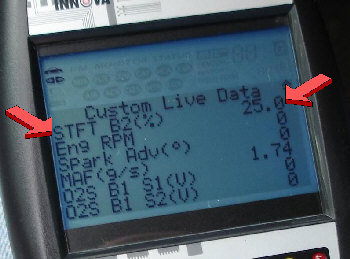
This scantool is displaying a STFT value of 25 per centum. Normally that would indicate a problem,
but in this instance the engine is non running (Engine RPM is zero). Equally before long every bit the engine starts
and goes into airtight loop, the fuel trim readings will begin to change.
How Fuel, Ignition and Engine Bug Affect Fuel Trim
Lean fuel mixtures are a more common problem than rich fuel mixtures, though either tin happen depending on the cause.
LEAN fuel mixtures will generate higher than normal POSITIVE fuel trim readings on your scan tool.
RICH fuel mixtures will generate NEGATIVE fuel trim values.
Possible causes of LEAN fuel mixtures include:
Air or vacuum leaks in the intake manifold, most the throttle torso or at vacuum hose connections.
Weak fuel pump that is not generating enough pressure or volume
Fuel line restrictions (like a pinches hose or plugged filter)
A weak fuel pressure regulator that is not maintaining adequate fuel pressure
Air leaks in the PCV plumbing
Dirty MAF (Mass Airflow) sensor that is under reading airflow into the engine
Dirty or dead fuel injectors
Ignition misfire (a fouled spark plug, weak ignition curl or bad plug wire that causes a misfire allows unburned oxygen to pass into the frazzle and fool the O2 sensors)
Compression leaks (bad exhaust valve that allows unburned oxygen into frazzle and fools O2 sensors)
Exhaust manifold fissure or gasket leak (allows unburned air into exhaust and fools O2 sensors)
Bad O2 sensor (signal shorted to basis so the sensor reads lean all the fourth dimension)
Possible causes of RICH fuel mixtures include:
Leaky fuel injector
Excessive fuel force per unit area due to bad fuel pressure regulator or restricted fuel return line
Extremely dirty air filter or restrictions in air intake system
Frazzle restrictions (clogged converter, crushed exhaust pipe or plugged muffler)
Bad O2 sensor (output shorted to voltage so it reads RICH all the time)
Using Fuel Trim to Diagnose Problems
Apply Fuel Trim to Diagnose Vacuum and Fuel Delivery Leaks. With the engine idling, await at the Short Term Fuel Trim (STFT) and Long Term Fuel Trim (LTFT) values. Normal range may be loftier as plus or minus eight, merely closer to nix is best. If the numbers are +10 or higher for STFT and LTFT, your engine is running LEAN. Rev the engine to 1500 to 2000 RPM and hold information technology steady for half a minute or so. If the fuel trim numbers drops back down to a more normal reading, it confirms the engine has a vacuum leak at idle. This is because vacuum leaks have less of a leaning consequence on the fuel mixture as engine speed and load increment.
If the fuel trim readings exercise not change much, the lean fuel status is more likely due to a fuel delivery problem (weak fuel pump, restricted fuel filter, dirty fuel injectors or a leaky fuel pressure regulator) than a vacuum leak.
LTFT fuel trim readings that are trending high might besides be the consequence of a slight ignition misfire that is not bad enough yet to set up a misfire code but is bad enough to cause a drib in fuel economy. Ane or more fouled spark plugs that are misfiring occasionally, or a weak ignition ringlet or bad plug wire that is allowing some occasional misfires could be the cause. For more information on misfire diagnose, Click Here.
You lot tin use fuel trim to identify dingy fuel injectors. If the LTFT fuel trim readings are trending upward (POSITIVE), it ways the fuel feedback control system is compensating for an air/fuel mixture that is becoming progressively leaner over time. The most probable cause would exist dirty fuel injectors. Fuel commitment tin be restricted by the accumulation of varnish deposits inside the injector nozzles. The gear up here is to make clean the injectors. If the fuel trim values return to normal after the injectors accept been cleaned, it verifies you have solved the problem. If the fuel trim values don't change later on cleaning the injectors, the lean fuel condition may be due to low fuel pressure or air/vacuum leaks.
Y'all can apply fuel trim readings to check the response of the oxygen sensors and engine computer to changes y'all make in the fuel mixture. While the engine is idling, temporarily disconnect a vacuum hose. You should see the STFT fuel trim readings jump immediately and become POSITIVE, and the LTFT should get-go to pitter-patter upwardly in response to the artificial lean fuel mixture you have but created by disconnecting the vacuum hose.
To test a rich response, yous can feed some propane vapor from a pocket-size propane tank into the throttle body or a vacuum hose connection on the intake manifold. This time, you should see a drop in fuel trim readings, with STFT going NEGATIVE, and LTFT creeping downwardly in response to the rich fuel mixture.
No change in fuel trim readings when you create an artificial lean or rich fuel mixture would tell you the engine computer is Non operating in closes loop, or that the oxygen sensor(s) are non responding to changes in the fuel mixture.
Click Here to Download or Print This Article.

 More Fuel System Manufactures:
Air/Fuel Ratios More Fuel System Manufactures:
Fuel Trim past Wells Manufacturing (PDF file).
Ford P0171 & P0174 Lean Codes
How Fuel Injection Affects Emissions
Nigh Common Trouble Codes (and what causes them)
Mass Airflow Sensors
Oxygen Sensors
Wide Ratio Air Fuel (WRAF) Sensors
More on Check Engine Lights & Fault Lawmaking Diagnostics
Scan Tool Diagnostics
Decoding Onboard Diagnostics
Trouble CODES Help
OBD II Diagnostic Tips
Aid with DTC P0300 Random Misfire Codes
Troubleshoot Fuel Injectors
Troubleshoot Electronic Fuel Injection & Fuel Pump Diagnosis

Be sure to visit our other websites:

Auto Repair Yourself
CarleySoftware
OBD2HELP.com
Random-Misfire.com
Scan Tool Help
TROUBLE-CODES.com
Source: https://aa1car.com/library/what_is_fuel_trim.htm
0 Response to "What Does It Means When the Fuel Trim Reads -30"
Post a Comment